Thursday, September 29, 2011

Where Everybody Knows Your Name


When I was a teen, growing up in the '80s, one of my most comforting memories was of the opening credits to the popular TV show Cheers. Although I sometimes watched the show, and enjoyed it, I was never as big a Cheers fanatic as so many other people.  

But the opening credits were always a must see for me. The theme song itself was part of the attraction. It begins by noting the taxing nature of modern life (in the '80s), which "takes everything you've got," and then segues into the catchy refrain about wanting to be "where everybody knows your name."


But just as appealing were the montage of images which appeared along with the song, a series of pictures of people seemingly enjoying the pleasures of being at a pub, with its drinks and social life. The pictures all have a historical quality to them, lending the sense that such activity has occurred through time, and continues to the time of the program . . . the '80s and early '90s.

There is one photo, for example, which has people in a bar with drinks, with one man holding up a newspaper which reads "WE WIN" in all captal letters. Growing up, I had thought that the headline referred to the end of World war II, but it in fact refers to the end of Prohibition. In restrospect, this seems all the more appropriate given that the show takes place in a drinking establishment. 


Another photo shows a group of young males of another era, perhaps college kids, all trying to look dapper and sophisticated.

I always thought that the combination of words and music put forth the idea that time passes, but certain things remain the same. That so many things have come and gone through time and history, and that here we were, in the '80s, taking our place in time. Yet, some things were constant, through it all. Through it all, don't we all really want to sometimes go to a place "where everybody knows your name."


Making your way in the world today takes everything you've got.
Taking a break from all your worries, sure would help a lot.

Wouldn't you like to get away?

Sometimes you want to go

Where everybody knows your name,
and they're always glad you came.
You wanna be where you can see,
our troubles are all the same
You wanna be where everybody knows
Your name.

Friday, September 23, 2011

This One Goes Out To R.E.M.


The news came out recently that seminal '80s band R.E.M. was calling it quits. I guess all good things have to come to an end sometime.

R.E.M. was one of the most relevant bands from the '80s college radio music scene, and in the vanguard of alternative music.


The public at large became well aware of R.E.M. as a presence on the radio after their breakthrough in 1987, with The One I Love off of the album Document (1987). This was soon followed by Green (1988), with songs like Orange Crush and Shiny Happy People. By the end of the '80s, R.E.M. had a strong radio presence, and alternative music was on a roll.


However, its just as important to remember the R.E.M. of college radio, which was a major source of alternative music during the early to mid '80s. R.E.M. always struck me as having a certain Beatnik/Kerouac/Ginsberg quality about them, as if they were made to be listened to in a darkened coffee house over a strong expresso while thumbing through a well-worn copy of Howl. Their music at this time had a jangly style to it in some ways reminiscent of The Byrds. The above clip is their performance on the David Letterman show circa 1983. The song is So. Central Rain off of their album Murmur (1983). 


R.E.M. were actually part of a burgeoning alternative music scene in Athens, Georgia, a college town which became a bohemian mecca during the early and mid '80s, and an epicenter of the larger college radio phenomenon. The clip above is from Athens GA: Inside/Out, a fascinating documentary of this bohemian/alternative scene, and features members of R.E.M., as well as other bands of that scene.

Farewell, R.E.M., and thanks for the wonderful ride.

Tuesday, September 20, 2011

Thank you, John Hughes


Some of my most pleasant memories of being a teen in the '80s came from some of the better teen movies which flourished at that time. Foremost among the creators of this genre of moviemaking was the great John Hughes whose work during the '80s was known for treating the minds and feelings of teenagers, and the situations that teens found themselves in, with seriousness and respect.

Hughes created such teen classics as Weird Science, Sixteen Candles, Ferris Bueller's Day Off, and Pretty In Pink, movies which were big in their day, and have since become cult classics, and the source of much imitation in the form of subsequent teen oriented flicks. Hughes also went beyond the teen movie genre to make such films as the holiday classic Home Alone and the comedy Planes, Trains and Automobiles.  But Hughes' creation which, for many of us, still resonates most strongly was the teen classic The Breakfast Club.


An account of several teens from very different cliques bonding with one another during their stay in detention, The Breakfast Club served for many of us as a protest against the walls that separated us from our fellow teens. It also had an unusual depth for a teen flick, allowing its characters to express the complexity which lay behind the facades of various teen stereotypes. Kids who were as different as a nerd, a stoner, an arty outsider, a jock and a preppie suddenly seemed more than just one dimensional. I remember getting great pleasure out of the way this movie made you think, as you chewed on the dialogue going on between the characters on the screen.


But the thing that made The Breakfast Club, and all of Hughe's movies, so wonderful for a teen loner like me, is that Hughes had a particular soft spot for the outsiders, the individualists, and the misfits, and he had a great way of exposing their dilemma through his movies, and ultimately empowering them in the process.

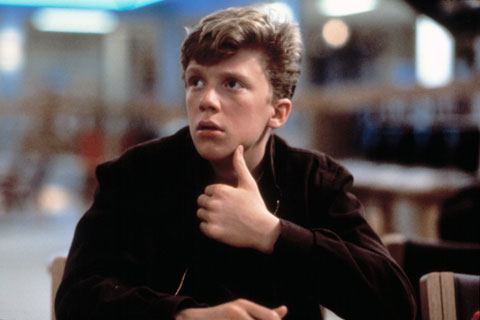
For example, there is this scene in the Breakfast Club, where the jock character, played by Emilio Estevez, tells about an awful thing, a pitiless prank that he played on this nerdy kid. He had done it to impress his fellow jock friends, but in the movie, he was expressing how bad he felt over his part in such a cruel prank, and how awful he must have made that hapless boy feel. At the conclusion of the jock's account, the nerd character, played by Anthony Michael Hall, quietly mentions that the boy who was the target of the prank was one of his friends. The scene is powerful, and there is this painful awareness as the nerd and the jock realize how close this awful prank struck each of them.

Thank you, John Hughes, for moments like that, which exposed the pain of being an outsider, and brought home just how much we had in common as teens from different backgrounds.


John Wilden Hughes (1950-2009)


Thursday, September 15, 2011

When Party Was a Verb


One of the interesting things to occur in the 1980s is that the word "party," began to be used more frequently as a verb. Perhaps it all began with the movie Fast Times at Ridgemont High during the early '80s, with the character of Jeff Spicoli, who became known for the quote: "Hey Bud, Let's Party."


Then it became a common theme in popular songs, such as Eddie Murphy's "Party All The Time."


And Prince's "1999"

I remember once being out with a few friends, and having the distinction impressed upon me as to the difference between "going to a party," and "partying." Apparently, "going to a party" meant going to a specific get together (something which I, as a teenage misfit and loner, didn't do too much), but "partying" was something which one could do wherever one was.

Some friends, some good rock n roll on the radio, and there you were, "partying."

Such were the '80s. I miss 'em.

Thursday, August 25, 2011

Spuds McKenzie: The Original Party Animal


Does anyone remember Spuds McKenzie?  Although he seems to have been forgotten nowadays, he was a popular advertising character during the late 1980s. Portrayed as "the original party animal," Spuds was the mascot, of sorts, for Bud Light beer during that decade.


Spuds was always portrayed as a fun-loving good times party goer, and always the center of attention, especialy from the ladies.


According to Wikipedia the very first Spuds McKenzie commercial aired as a Super Bowl ad in 1987. Also, interestingly, Spuds, a Bull Terrier, "who was portrayed as male in the commercials, was actually female."

Alas, Spuds, whose real name was Honey Tree Evil Eye, succumbed in 1993 to kidney failure.

Here's to you Spuds . . . may you always be in that never-ending '80s party in the sky.


Monday, August 8, 2011

MTV: Video Made The Radio Star


A belated tribute to MTV on their 30th annivaersary.

I was reminded by posts at Retrospace and Go Retro! blogs that MTV was celebrating its 30th anniversary.

Indeed, MTV was launched on August 1, 1981. According to Wikipedia :

 MTV launched with the words "Ladies and gentlemen, rock and roll,"
spoken by John Lack, and played over footage of the
first Space Shuttle launch countdown of Columbia
(which took place earlier that year) and of the launch
of Apollo 11. Those words were immediately followed by the original
MTV theme song, a crunching classical tune composed by Jonathan
Elias and John Petersen, playing over photos of the Apollo 11
moon landing, with the flag featuring MTV's logo changing
various colors, textures, and designs.

The innovative music channel would become a central part of life in the '80s, especially if you were young and into the vibrant music of that era.


I remember these colorful "I Want My MTV" commercials well.

According to Wikipedia the first music videos played on MTV were:

  1. "Video Killed the Radio Star" by The Buggles
  2. "You Better Run" by Pat Benatar
  3. "She Won't Dance with Me" by Rod Stewart
  4. "You Better You Bet" by The Who
  5. "Little Suzi's on the Up" by Ph.D.
  6. "We Don't Talk Anymore" by Cliff Richard
  7. "Brass in Pocket" by The Pretenders
  8. "Time Heals" by Todd Rundgren
  9. "Take It on the Run" by REO Speedwagon (the video begins but ends after a few seconds due to technical difficulties.)
  10. "Rockin' the Paradise" by Styx


Ironically, notwithstanding the name of the song, MTV probably brought more vibrancy and life to early and mid '80s radio, as it opened up the media to newer music groups

Thursday, August 4, 2011

Not Those '80s Hair Bands. . .


The phrase "'80s hair band" has usually been applied to glam metal, but heres examples of two bands whose unique hair styles mark them as products of the '80s . . . fun, bizarre, wild products of a fun, bizarre, wild era.


The band A Flock of Seagulls have become memorable in part due to the quirky hair of their lead singer, Mike Score. His "waterfall" hair style is today remembered as one of the more garish examples of '80s new wavish fashion.


But just as equally memorable (once you've seen it, you can't quite forget it) was the band's video for the 1983 hit "I Ran (So Far Away)." Another '80s new wave video artifact made apparently with garbage bags, makeup, and a lot of mirrors, watching the video remains a frolic through '80s quirkiness . . . the thing that made the '80s such a fun time to have grown up in.

I always thought this video resembled the kind of odd dream that occurs after youve eaten too much pizza.


But not to be outdone in quirky, wild '80s new wave stylings is the band Dead or Alive, whose lead singer, Pete Burns, is no slouch to pushing the boundaries of fashion, hair and otherwise. Burns was androgynous, colorfully clothed, and armed with a hard-to-miss hairstyle as well as an eyepatch. Alas, he has been more recently in the news due to personal problems.

I remember seeing for the first time their video to "You Spin Me Round (Like a Record)," and hearing the utterly catchy song that went with it.